
Running regular cemetery management reports is crucial for understanding your cemetery's operational health and financial stability. Even for small cemeteries, monthly reporting on inventory, sales, accounts receivable, interments, pre-need contracts, and perpetual care funds provides the clarity needed to make informed decisions. These reports help you track progress, identify potential issues before they become crises, and ensure long-term sustainability.
What are the most important cemetery management reports?
The most important cemetery management reports are those that give you a clear, recurring snapshot of your core operations: available inventory, sales performance, cash flow, interment activity, future obligations, and trust fund health. While every cemetery is unique, a standard set of monthly reports provides a consistent baseline for tracking performance and planning for the future. Without this data, you are essentially flying blind, relying on guesswork rather than facts to guide your decisions.
These reports don't need to be complicated. The goal is consistency. By running the same reports each month, you can spot trends, celebrate successes, and address challenges proactively. This practice is fundamental to good governance and stewardship, demonstrating to your board, community, and future generations that the cemetery is in capable hands. Whether you use dedicated software or a well-organized spreadsheet system, establishing this monthly discipline is a key step toward professionalizing your operations.
1. Available Inventory Report
An available inventory report lists all saleable spaces in your cemetery that are currently unoccupied and unsold. This is your most fundamental operational report, as it tells you exactly what you have left to sell. It should detail the quantity, type (e.g., traditional grave, cremation niche, crypt), and location (section, lot, space number) of all available inventory. For many cemeteries, this is the primary source of operational revenue, making an accurate count essential for financial forecasting.

Running this report monthly helps you monitor your sales velocity and identify which types of inventory are moving quickly and which are not. This insight allows you to adjust your sales strategy, marketing focus, and even future development plans. For example, if you see that cremation niches are selling much faster than traditional burial plots, it might signal a need to develop more niche walls or cremation gardens. It also helps prevent the nightmare scenario of accidentally selling the same plot twice, a costly and emotionally damaging error that modern record-keeping can eliminate.
A detailed inventory report should include:
- Space ID: A unique identifier for each grave, niche, or crypt.
- Location: Cemetery, section, subsection, lot, and space number.
- Type: The kind of space (e.g., single grave, family plot, mausoleum crypt).
- Status: Clearly marked as 'Available'.
- Price: The current list price for the space.
Cemetery software like Sunset can generate this report instantly, pulling from a central database that updates in real time as sales are made. This automates what can otherwise be a painstaking manual process of cross-referencing paper maps, lot cards, and sales binders.
2. Sales and Revenue Report
A sales and revenue report summarizes all sales transactions completed within the month. This report is your primary tool for measuring financial performance against your goals. It should break down sales by category, such as plot sales, interment fees (openings and closings), marker sales or setting fees, and pre-need contract payments. This provides a clear picture of where your revenue is coming from and helps you understand the financial pulse of your cemetery.
Analyzing this report monthly allows you to track revenue trends, evaluate the effectiveness of your pricing structure, and forecast future income. If revenue is down, you can dig deeper to see if it's due to fewer plot sales, a drop in interment services, or another factor. This level of detail is critical for making strategic adjustments. For example, if plot sales are strong but revenue from services is weak, you might examine how those services are presented to families at the time of need.
Your sales report should clearly distinguish between at-need and pre-need sales. This is vital for understanding both your current cash flow and your future revenue pipeline. A healthy cemetery typically has a balanced mix of both. This report is also a key document for your accountant and board, providing a transparent summary of the month's financial activity. Systems that offer a centralized way to manage records make pulling this data straightforward, especially if they can export information for accounting software like QuickBooks Online or Sage 50.
3. Accounts Receivable (A/R) Aging Report
An accounts receivable aging report lists all unpaid invoices from families and customers, categorizing them by how long they have been outstanding. This report is essential for managing your cemetery's cash flow. It typically groups overdue payments into columns such as 0-30 days, 31-60 days, 61-90 days, and 90+ days. This allows you to see at a glance who owes you money and how urgent the collection effort needs to be.
Running an A/R aging report every month is non-negotiable for financial health. It helps you identify collection problems early so you can follow up with families before the debt becomes significantly aged and harder to collect. A gentle, timely reminder is often all that's needed, but without a systematic way to track who owes what, these follow-ups can easily fall through the cracks. Consistently high numbers in the 60+ day columns are a red flag that your collection process needs improvement.
This report is particularly important for cemeteries that offer payment plans for plots or services. It helps you ensure that families are keeping up with their agreed-upon schedules. When reviewing the report, pay close attention to the oldest balances. You may need to establish a policy for handling delinquent accounts, which could involve more direct communication or pausing further services until the account is brought current. Remember to always approach these conversations with compassion, as families may be facing difficult circumstances. The goal is to collect what is owed while preserving the cemetery's relationship with the community.
4. Interment and Burial Report
An interment and burial report provides a complete list of all interments, inurnments, and entombments that occurred during the month. This report is a critical record of your cemetery's core activity and a vital part of its permanent historical archive. It serves both operational and historical purposes, confirming that all scheduled services were completed and properly documented. Each entry should include the decedent's full name, date of death, date of interment, and the precise location of the burial (section, lot, and space).
Monthly review of this report helps ensure the accuracy of your permanent records. It provides an opportunity to cross-check information from the service order against the final record, catching any data entry errors before they become permanent. This report is also valuable for logistical planning. By tracking the number and type of interments over time, you can better forecast staffing needs, equipment requirements, and grounds crew workload throughout the year, noting seasonal peaks and lulls.
Furthermore, this report is a key source of data for genealogists, historians, and families researching their heritage. Maintaining an accurate, accessible record of every person laid to rest is one of a cemetery's most sacred duties. As we discussed in our article about why we built Sunset, this responsibility to history and to families is at the heart of cemetery work. Modern software helps ensure this data is captured correctly at the time of service and preserved securely for centuries to come.
5. Pre-Need Contract Status Report
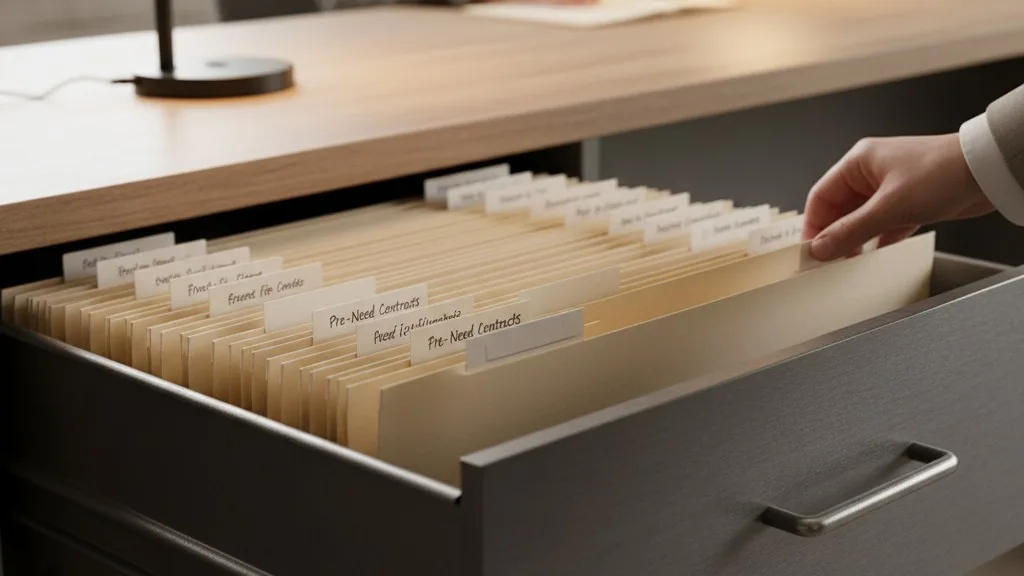
A pre-need contract status report tracks the progress of all active pre-need arrangements, showing which are fully paid and which are still in progress. This report is crucial for understanding your future obligations and revenue. Unlike at-need sales, pre-need contracts represent services and property that the cemetery is obligated to provide at a later date. This report should detail the total contract value, the amount paid to date, and the remaining balance for each pre-need plan.
Reviewing this report monthly gives you a clear view of your future revenue stream from maturing pre-need plans. It also highlights any payment plans that have become delinquent, allowing you to follow up with the contract owner. Because pre-need sales are often placed into trust funds as required by state or provincial law, this report is essential for compliance. It provides the data needed to ensure you are making the correct deposits into your merchandise and services trust and your perpetual care trust.
This report acts as a bridge between your sales team and your accounting department. It confirms that new pre-need sales are being recorded correctly and that payments are being applied properly. For long-term planning, understanding the total value of your outstanding pre-need contracts is critical. This represents a significant portion of your future business, and managing it well ensures that you will have the funds available to deliver on your promises when the time comes.
6. Perpetual Care Fund Activity Report
A perpetual care fund activity report summarizes the deposits into, earnings of, and any withdrawals from your cemetery's perpetual or endowment care trust fund. This report is fundamental to the long-term stewardship of the cemetery. The health of this fund determines your ability to maintain the grounds for generations to come, long after the cemetery is full and no longer generating significant operational revenue. The report should show the fund's starting balance, all contributions from plot sales during the month, investment gains or losses, and the ending balance.
State and provincial regulations often dictate the percentage of each plot sale that must be deposited into the perpetual care fund, so this report is a key compliance document. Running it monthly ensures you are meeting your legal obligations and provides a clear record for auditors. You should work with your financial advisor or the institution managing the trust to obtain the necessary figures for investment performance. This transparency is vital for your board of directors and demonstrates responsible financial management.
Beyond compliance, this report is your primary tool for gauging the long-term financial sustainability of the cemetery. Is the fund growing at a rate that will cover future maintenance costs, accounting for inflation? Are contributions being made consistently? Answering these questions requires diligent tracking. A healthy perpetual care fund is the ultimate promise you make to the families you serve—a promise that their loved ones' final resting place will always be a place of dignity and peace. This report tells you if you are on track to keep that promise.
Frequently asked questions
How often should I back up my cemetery reports?
You should back up your cemetery reports as part of your overall data backup strategy. If you are using cloud-based software like Sunset, your data is continuously backed up automatically. If you are using local spreadsheets or desktop software, you should perform backups at least daily to an external drive or cloud storage service. Monthly reports should be saved and archived in a secure, permanent location as soon as they are generated.
What's the difference between a sales report and an accounts receivable report?
A sales report shows you what you have sold within a specific period (like a month), reflecting the total value of new contracts and transactions. An accounts receivable report, on the other hand, shows you what money is currently owed to you from past sales, regardless of when the sale was made. Both are crucial: the sales report measures your performance, while the A/R report measures your cash flow.
Can I run these reports without special software?
Yes, you can create and run these reports using spreadsheets, but it requires significant manual effort and a high degree of organization. The primary challenges are ensuring data is entered accurately and consistently, linking data between different sheets (e.g., sales and inventory), and avoiding formula errors. As a cemetery grows, this manual process becomes increasingly time-consuming and prone to error, which is why most cemeteries eventually adopt specialized management software.
Consistent Reporting Builds a Stronger Cemetery
Running these six reports consistently every month is a foundational practice for any well-managed cemetery, regardless of its size. They replace assumptions with data, enabling you to steward your sacred grounds with confidence and foresight. From tracking available graves to ensuring the long-term health of your care fund, this regular flow of information empowers you to serve your community better and secure your cemetery's future.
Making this process easier is why we built Sunset. It provides a single source of truth for your spaces, ownership records, and financials, turning complex reporting into a simple task. If you're ready to spend less time chasing data and more time making informed decisions, we'd be glad to show you how it works. Book a conversation with our team today.